::::::::::::::::::::::::::::::::::::::::::::::::::::::::::::::::::::::::::::::::::::::::::::::::::::
Seven Herbs of Autumn (aki no nanakusa)
***** Location: Japan
***** Season: Early Autumn
***** Category: Plants / Humanity
*****************************
Explanation

Kaii Otsuki no hara 甲斐大月の原
Utagawa Hiroshige 歌川広重
The seven flowers of autumn, aki no nanakusa
秋の七草
Flowers blossoming
in autumn fields -
when I count them on my fingers
they then number seven.
The flowers of bush clover,
eulalia, arrowroot,
pink, patrinia,
also, mistflower
and morning faces flower.
aki no no ni
sakitaru hana o
yubi orite
kaki kazoureba
nana kusa no hana
hagi ga hana
obana kuzubana
nadeshiko no hana
ominaeshi
mata fujibakama
asagao no hana
Yamanoue Okura (C. 660 - 733)
Manyoshu: 8:1537-8
The seven grasses of autumn were often mentioned in verses of the Manyoshu, the earliest collection of Japanese poetry and song. Images of autumn grasses in a later anthology of court poetry, the Kokinshu, illustrate the culture of Heian Japan [784 - 1185] in a way that could not be captured by painting. Powerful and concise language draws out the subtle nuances of life and love at the time, just as nature and flowers invoke the mutable seasons of interior emotion.
The capacity of the autumn grasses for inspiring deep emotion among people in olden days may be viewed through their composite nature of beauty tinged with sadness. More than flowers of any other season, autumn grasses washed by rain and bent in the wind attain a beauty unsurpassed, and this is the beauty of flowers for the tea ceremony.
CLICK here for more ENGLISH information!
Urasenke Tea Ceremony
http://www.urasenke.org/new/flowers/index.html


The common theme of these seven flowers is the ""the pathos of things", also translated as "an empathy toward things" or "a pity toward things" (mono no aware 物の哀れ).
The chrysanthemum is notably absent in this flower collection.
But the chrysanthemum has its own festival on the ninth day of the ninth month, Choyo no sekku.
:::::::::::::::::::::::::::::::::::::::::::::::::::::::::::::::::::::::::::::::::::::::::::::::::::::
Bush clover (hagi)
Lespedeza fam.
hagihara 萩原 field with bush clover
Pampas grass (susuki)
Miscanthus sinensis
:::::::::::::::::::::::::::::::::::::::::::::::::::::::::::::::::::::::::::::::::::::::::::::::::::::
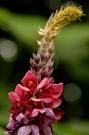
Kudzu flower, arrowroot flower, kuzu no hana
(くずのはな) 葛の花
kuzu 葛 (くず) Kudzu, Knabenkraut, Pfeilwurz
kuzu no ha 葛の葉 arrowroot leaves
kuzu kazura 葛かずら(くずかずら)Kudzu-Vine
makuzu 真葛 genuine kudzu
Pueraria lobata
Just using the word "arrowroot (kuzu)" in haiku refers to the leaves of the plant, which are white at the backside and theme of many poems since olden times.
Arrowroot is very strong and lively, the violet flowers stand up between the leaves and are full of power.
A person like a kuzu, "ningen no kuzu" means "human garbage".
makuzuhara 真葛原 (まくずはら) plain of genuine arrowroot
. fuusenkazura 風船葛 (ふうせんかずら)
Candiospermum halicacabum
kuzu horu 葛掘る (くずほる) digging for arrowroot
. . . . . kuzune horu 葛根掘る(くずねほる)
. . . . . kuzu hiku 葛引く(くずひく)pulling out arrowroot
kigo for late autumn
kuzu sarashi 葛晒し (くずさらし) bleaching arrowroot
kigo for late winter
.................................................................................
kigo for early summer
tama maku kuzu 玉巻く葛 (たままくくず) kudzu forming a ball
..... 玉真葛(たままくず)
tamakuzu 玉葛(たまくず)"kudzu ball"
The first green leaves of the plant are still rounded.
:::::::::::::::::::::::::::::::::::::::::::::::::::::::::::::::::::::::::::::::::::::::::::::::::::::
Large pink (nadeshiko) Wild Carnation
fringed pinks
::::::::::::::::::::::::::::::::::::::::::::::::::::::::::::::::::::::::::::::::::::::::::::::::::::

yellow flowered valerian, "maiden flower" ominaeshi
女郎花 (おみなえし)
Patrinia scabiosaefolia
ominameshi おみなめし
awabana 粟花(あわばな)"millet flower"
OMINA means "Woman (onna)" and the yellow flowers remind the Japanese of sweet chestnuts cooked with rice (kuri gohan) .. eshi ... meshi ..
On a long stem there are small yellow flowers and we can enjoy them swaying in the wind. These flowers are rather feminin and gentle in their poetic feeling. When written in hiragana, this feeling is felt double.
The flower has been a favorite in Heian court poetry.
名にめでて折れるばかりぞ女郎花
我おちにきと人にかたるな 秋歌上
na ni medete oreru bakari zo ominaeshi
ware ochiniki to hito ni kataru na
I'm charmed by your name --
for that alone I plucked you.
O maidenflower,
don't tell anyone that
I have fallen from my vows.
Priest Sojo Henjo 僧正遍照 (816 - 890)
source : L. Hammer
. Soojoo Henjoo 僧正遍照 Sojo Henjo .
(for the hokku by Matsuo Basho, see below.)
- - - - -
七転び髪八起の花よ女郎花
nana korobi ya oki no hana yo ominaeshi
seven tumble down
eight rise up...
maiden flowers
Issa
Tr. David Lanoue
Seven times down and eight times up, this refers to the famous
Daruma san だるま さん !
and the courtesans of the Yoshiwara quarters.
...........................................
There is another flower of this family, written with the Chinese character for MAN,
otoko eshi 男郎花, which has white flowers and a thick stem.
Patrinia villosa
otokomeshi おとこめし
oodochi no hana 荼の花(おおどちのはな)
haishoo 敗醤(はいしょう)


::::::::::::::::::::::::::::::::::::::::::::::::::::::::::::::::::::::::::::::::::::::::::::::::::::

Boneset, fujibakama ふじばかま 藤袴
Eupatorium fortunei
The stem can be more than one meter long. The flowers can be pinkish or white. The flowers resemble a person dressed in a formal Japanese trouser (hakama), hence the name (bakama .. hakama).
This flower also has been the theme of many waka poems of elegance and beauty. Its color fades with the deepening of autumn. It has a faint smell which gets stronger if you break the stem.
Hakama, the formal trouser-skirt
::::::::::::::::::::::::::::::::::::::::::::::::::::::::::::::::::::::::::::::::::::::::::::::::::::

baloon flower, Chinese bellflower,
kikyoo ききょお kichikoo 桔梗
Platycodon grandiflorus.
- Sometimes the asagao is quoted instead :
. Morning-Glory (asagao 朝顔) Convolvulaceae family. .
The pronounciation in Japanese can also be: kichikau きちかう, kichikou きちこう.
She flowers in places with a lot of sunshine. Her color is especially beautiful. There are also white flowering plants.
kigo for mid-autumn
. rindoo 竜胆 (りんどう) gentian, autumn bellflowers
sasarindoo 笹龍胆(ささりんどう)
Gentiana scabra
...............................
sawakgikyoo 沢桔梗 (さわぎきょう) Lobelia sessilifolia
choojina ちょうじな
kigo for early autumn
...............................
kigo for spring
buds of the bell flower, 桔梗の芽 (ききょうのめ)
kigo for late summer

"Stone Baloon Flower", iwa gikyoo 岩桔梗 (いわぎきょう)
Campanula lasiocarpa

Chijima Island Baloon Flower,
Chishima kikyoo 千島桔梗 (ちしまききょう)
Campanula chamissonis
She flowers in the harsh climate of the mountain ranges in Hokkaido and the Chishima Islands in the north of Japan.
*****************************
Worldwide use
*****************************
Things found on the way
*****************************
HAIKU
見るに我も折れるばかりぞ女郎花
miru ni ga mo oreru bakari zo ominaeshi
when I look at you
I will also break my vows -
maidenflower
Tr. Gabi Greve
Written in the years of Kanbun, Basho age 18 to 29 寛文年間
When he was making the decision to leave Iga Ueno for Edo.
A parody about the waka by
. Soojoo Henjoo 僧正遍照 Sojo Henjo .
(see above)
. Matsuo Basho 松尾芭蕉 - Archives of the WKD .
:::::::::::::::::::::::::::::::::::::::::::::::::::::::::::::::::::::::::::::::::::::::::::::::::::::::
角力とりや是は汝が女郎花
sumootori ya kore was nanji ga ominaeshi
sumo wrestler,
these woman flowers
are yours!
This hokku is from lunar 8/7 (mid-September) of 1810, when Issa was in Edo, where the elite sumo wrestlers competed. The first line almost surely has six syllables, since sumou has a long 'o' in Japanese, as indicated by the editors of Issa's diary in the complete works (3.75) and by Maruyama Kazuhiko, who separately edited Issa's Seventh Diary and his selected hokku. And Issa is not averse to "long" six-syllable first lines. In referring to the wrestler, Issa uses the polite second-person pronoun nanji, presumably because of his high status within the sport as a top wrestler. However, nanji wasn't as stilted as "thy" sounds in English. In a later variation Issa uses the neutral sonata for "you." Did he feel it was more intimate and showed the common humanity he shares with the wrestler?
What is often romantically translated into English as "maiden flower" is literally "woman flower," since omina refers to a mature woman, often an older woman. This autumn-blooming meadow plant has clusters of small yellow flowers standing at the top of long, elegant stalks, and the folk etymology of the plant name is that the way the long stalks bend and sway in the wind suggests something female to males. In Issa's hokku, he may be symbolically offering a stalk of the flowers to the wrestler, or he may be telling the wrestler that these woman flowers are "yours" because they are like him and best express the self-image the wrestler is unconsciously projecting to Issa.
In either case, it seems to be the thin, unmuscular, delicate quality of the flowers that causes Issa to want to give some of the flowers to the big, corpulent, muscular wrestler. Issa usually sympathizes with losing wrestlers more than with the winners, and he likes to point out situations in which the apparently invulnerable wrestlers show vulnerability or unexpected sensitivity. In the present hokku he may be addressing the soul of the wrestler and saying that he knows the wrestler has a very sensitive part inside the armor-like male body that he has built up. In another hokku Issa mentions a wrestler with a stalk of flowers stuck in his topknot, so he may be wishing the wrestler in the above hokku would show his other side and wear woman flowers in his hair.
Is Issa engaged in gender bending? I don't know, but he was familiar with the Yi Jing and with yin-yang philosophy, and that means he was familiar with the basic principle that extreme yin turns into yang and extreme yang turns into yin, and he may feel the sumo wrestler embodies an extreme yang position. The hokku before this one in Issa's diary also associates a sumo wrestler with a delicate flower that is very sensitive to light and to its surroundings -- a morning glory.
Chris Drake
. Sumo wrestling 相撲 .
.............................................................................
世の中はくねり法度ぞ女郎花
yo [no] naka wa kuneri-hatto zo ominaeshi
woman flower
you know we have laws
against such curving
Tr. Chris Drake
This hokku was written in the 8th month (September) of 1812, while Issa was still based in Edo but was on a short trip back to his hometown to prepare for moving back there. In the hokku Issa seems to be flirting with and teasing a woman flower beside a path somewhere. There is a long tradition in Japanese poetry of addressing woman flowers as if they were human women, one that goes back in the early days of waka, when womina (not cognate with English 'woman') meant "beautiful woman," but by Issa's time the pronunciation was omina, and it referred to any grown woman.
It is often translated as "maiden flower," but there was another word for girl or young woman: ominago. In autumn the tiny bright yellow flowers of the bush grow in wide clusters at the top of long, tall stalks that curve gracefully when they bend in the wind, and the stalk is rather thick, allowing it to bend far and sinuously. The strong yellow of the flowers almost equals that of spring rapeseed blossoms, but the flower clusters are diaphanous and more delicate.
Issa addresses the flower (actually a cluster of tiny flowers) with mock solemnity and outrage, telling "her" that, as everyone knows, the samurai authorities have instituted laws against the kind of bending and curving she is doing outside in broad daylight. Does she think she can brazenly ignore the law and sinuously bend and sway right beside a public road? Issa no doubt refers to numerous laws and injunctions, beginning with the outlawing of female Kabuki troupes in 1629, that made it a crime for women to perform in public or wear stylish or provocative robes in public.
The obvious irony saturating Issa's pompous warning of course strengthens the compliment Issa is paying to the flower and to the eye-catching way the stalk and flower move in the breeze. Issa also seems to be parodying the various laws themselves by claiming they apply even to flowers. This hokku seems to be still another oblique criticism by Issa of the authoritarian and highly patriarchal samurai ruling class.
Chris Drake
ominaeshi karamitsuki-keri shiwa-ashi ni
womanflower
wrapping around
my wrinkled foot
. Comment by Chris Drake .
:::::::::::::::::::::::::::::::::::::::::::::::::::::::::::::::::::::::::::::::::::::::::::::::::::::::
nora ni saku na wa kore made zo kusa no hana
Flowers of the grass:
scarcely shown, and withered
name and all.
.. Asei
*****************************
Related words
***** Seven Herbs of Spring (haru no nanakusa) (Japan)
***** . kanokosoo 纈草 (かのこそう) Valeriana officinalis .
Baldrian
AUTUMN PLANTS - SAIJIKI
[ . BACK to WORLDKIGO . TOP . ]
:::::::::::::::::::::::::::::::::::::::::::::::::::::::::::::::::::::::::::::::::::::::::::::::::::::


 Posts
Posts


12 comments:
Rose's child in the
seven grasses of autumn--
(aki no nanakusa)
we spread Dad's ashes.
maiden flowers--
after one windy night
fallen
ominaeshi hito yo no kaze ni otorofuru
.女郎花一夜の風におとろふる
by Issa, 1825
Tr. David Lanoue
鉄砲の先に立たり女郎花
teppoo no saki ni tachitari ominaeshi
in the musket's
line of fire...
a maiden flower
Kobayashi Issa
Susumu Takiguchi assisted in the translation of this haiku. He points out that guns were "brought to Japan for the first time by the shipwrecked Portuguese in 1543 (some say 1542), and revolutionised the way battles were fought and castles were designed.
They were initially 'hinawa-ju' (matchlock or firelock) and this must be the type of 'teppo' which Issa was talking about."
(Tr. David Lanoue)
.
ominaeshi
「米のなき時は瓢におみなえし」(芭蕉)
Matsuo Basho
”「この句を学者や注釈者は、芭蕉庵の俗塵を払った簡素で清貧な生活がうかがえるというふうに解釈してしまう。いかにも観念的なきれいごとの解釈だが、それでいいのか・・ぼくには「をみなえし」が何ともいい。「をみなえし」は、一名粟花といって、そこか米とも似通うイメージがあって、「をみなえし」を挿すところが何ともうまいと思う。何度も腹を減らした経験があって、いまも腹をならしているかも分からない。そうした人生の辛酸を経てきた上での「をみなえし」にはそうした男のやさしさがある。単に「芭蕉庵の清貧な生活」では足りないだろう。やはり人生を知った者の、やさしさ、そしてユーモアがあり、芭蕉の句としてもいい句だと思う。こういう句は、子規以来の写生句には絶対出てこないと思う。
そういう意味で、近代の子規が唱えた写生だとか、虚子がいった客観写生だとか、そういうものは俳句の全幅、俳句を覆う方法として僕は信じない。しかし、虚子はたとえば、<去年今年貫く棒の如きもの>にしろ<龍の玉深く蔵すといふことを>の句にしても、これはいわゆる客観写生ではない。虚子は大人物だから、そういうことを十分心得て写生を説いた。虚子のいう写生は、信じてもいいけれど、その末流のもの、見ては写すだけのこまごました写生をぼくは信じない。
一句の抱える世界、つまり<米のなき時は瓢に>という、大きな人生で何かを包むような詠み方を忘れた、と同時に、<米のなき時は瓢にをみなえし>には、ある種の滑稽と、大きな人生の味を包んで、切ないものがあるけれども、現代俳句はおおかた人生的な詠み方が消えてしまった感じがする。写生も必要だろうが、いわば自然なり人生を大きく包んで、この句の「をみなえし」のような切なく、余裕のあるやさしさ、そういう詠い方が現代の俳句にあってもいいと思う”
http://blog.goo.ne.jp/rokuai57/e/d7f150f251b8406b33b6893bcea5d885
kome no naki toki wa hisago ni ominaeshi
米のなき時は瓢にをみなへし
When there is no rice,
the ominaeshi flower
in the gourd.
.
(tr. R.H.Blyth)
ひよろひよろとなほ露けしや女郎花
hyoro hyoro to / nao tsuyu keshi ya / ominaeshi
trembling, teetering
now even more dew-like -
lady flowers
Tr. Barnhill
tsuyukeshi, a variant of tsuyukesa
Kobayashi Issa
女郎花からみ付けり皺足に
ominaeshi karamitsuki keri shiwa ashi ni
entwined
by the maiden flower...
my wrinkled foot
Shinji Ogawa believes that this haiku might allude to Issa's first wife, Kiku.
Tr. David Lanoue
.
里宮も戸隠道も葛の秋
satomiya mo Togakushi michi mo kuzu no aki
at the village shrine
and at the road to Mount Togakushi -
arrowroot in autumn
Nishimoto Itto 西本一都 (1907 - 1991)
MORE about villge shrines
Matsuo Basho, Sarashina Journal
ひよろひよろと尚露けしや女郎花
hyorohyoro to nao tsuyukeshi ya ominaeshi
A yellow valerian
With its slender stalk
Stands bedecked
In droplets of dew.
MORE
about Sarashina
Tr. Yuasa
別子銅山のぼれば桔梗また桔梗
Besshi doozan noboreba kikyoo mata kikyoo
Besshi copper mine
climbing up there are Chinese bellflowers
and more bellflowers
津村芳水 Tsumura Hosui
.
The Besshi copper mine (別子銅山 Besshi dōzan).
http://edoflourishing.blogspot.jp/2015/12/sumitomo-family-business.html
.
Yosa Buson
初霜や吹き返しある葛の葉に
hatsushimo ya fukikaeshi aru kuzu no ha ni
The year's first frost--
On the kudzu leaves
Flipped over by the wind before.
Tr. Nelson and Saito
First frost of the year!
On the kudzu leaves that are
blown upside over.
The broad kudzu leaves attached to the vine are easily blown around by the wind and Japanese poets have been writing about them for centuries. Bashō wrote a haiku about noticing the frost on the front of the leaves and Buson is noticing it on the leaves that have been turned upside by the wind.
Another example of the different positional kind of perception that Buson was able to look at the world with.
Tr. and comment James Karkoski - facebook
.
https://edoflourishing.blogspot.jp/2016/10/buson-hatsumono-first-things.html
.
Yosa Buson
くず葛の葉のうらみ顔なる細雨かな
kuzu no ha no uramigao naru kosame kana
this light rain
almost line the resentful face
of Lady Kuzunoha . . .
kuzunoha in Haiku is often used implying the feeling of a grudge, bitterness and resentment.
The light rain here represents the tears of Lady Kuznoha when leaving her baby behind, because her husband found out she was a fox.
.
Painting
The Fox-woman Kuzunoha Leaving Her Child - Tsukioka Yoshitoshi 月岡 芳年
.
http://omamorifromjapan.blogspot.jp/2011/06/abe-no-seimei.html
.
Tokyo Katsushika ku 葛飾区 Katsushika ward
"decorated with kuzu 葛 arrowroot "
.
https://edoflourishing.blogspot.com/2018/06/katsushika-ward-shibamata.html
.
Post a Comment