::::::::::::::::::::::::::::::::::::::::::::::::::::::::::::::::::::::::::::::::::::::::::::::::::::
Games and Toys for the New Year
***** Location: Japan
***** Season: New Year
***** Category: Humanity
*****************************
Explanation
New Year is a time for traditional games and traditional toys.
:::::::::::::::::::::::::::::::::::::::::::::::::::::::::::::::::::::::::::::::::::::::::::::::::::

hagoita battledore
.......................................................................
Ball game (temari 手毬 (てまり)
with a decorative cotton ball
song for the ball game 手毬唄(てまりうた temari uta)
Ball game for kicking (kemari 蹴鞠初め)
a court ritual
.......................................................................
Battledore, Shuttlecock (hagoita 羽子板)
.......................................................................
Card Games (karuta 歌留多) hanafuda, uta karuta.
toranpu トランプ trupm and many more
.......................................................................
coin-throwing game 穴一 (あないち) ana-ichi, anaichi
..... ana ichi 穴市(あないち)
..... ana ichi zeni 穴一銭(あないちぜに)coin for ana-ichi
This game was quite popular in Edo around 1740. Young people played it. A hole the size of a coin was carved in the ground and then from a distance you throw a coin or small ball in it.

coin for the ana-ichi game
. menko 面子・めんこ・メンコ playing cards .
used for anaichi
穴一のあなかしましや花の陰
ana-ichi no ana kashimashi ya hana no kage
an uproar 'round
the penny toss hole...
blossom shade
Shinji Ogawa notes that Issa is punning with the word ana, which can mean "hole" and "indeed." Hence, ana kashimashi denotes "the hole is noisy" and also "indeed noisy."
Buddhists maintain that there are "Six Ways" of possible future life reincarnation:
(1) as a sufferer in hell, (2) as a hungry ghost, (3) as an animal, (4) as an angry demon, (5) as a human being, or (6) as a heavenly being.
This haiku is poem 4 of a six-poem series on the Six Ways. Two versions of this series exist; one appears in the 1812 book, Kabuban, while the other was published posthumously by Issa's students in Issa hokku shû in 1829. The present haiku appears only in the original, 1812 version.
Referring to a gambler's game of throwing coins into a hole, Issa suggests that the loud gamblers are like angry demons--oblivious to the beauty of the blossoms above them.
In my essay, "At the Crossroads of Six Ways: A Haiku Buddhist Vision of Life, Death, and Everything," I stated that an unseen animal inside the hole raises the ruckus in the haiku. I now believe that the gamblers themselves are doing this.
David Lanoue
. Kobayashi Issa 小林一茶 in Edo .
.......................................................................
青柳や十づつ十の穴一に
aoyagi ya juu-zutsu juu no ana ichi ni
greening willow --
children toss shells
at ten different holes
This hokku is from lunar 2/19 (April 3) in 1809, when Issa was in Edo. It is about a children's game played by both boys and girls that was especially popular at and soon after New Year's. In the middle of the 18th century this traditional game began to be played with copper coins, and soon adults were using the coins for gambling, so coins were outlawed in 1806, three years before this hokku was written. Therefore I take the hokku to be about children playing just for fun. Though Issa doesn't mention the material, the most common objects used in the game in the Edo area were the round shells of sea snails, the hard berries of soapberry trees, small stones, and nuts.
In its simplest form, the object of the game was to toss a shell or similar round or semiround object into a round hole about four inches wide from behind a line drawn on the ground about three feet away. If your shell went into the hole, you got to take it out and keep it, but if it fell on the ground near the hole, you had to leave it there, and the next player had the option of trying to hit it directly with his or her shell. If the hit was successful, this player got to keep both shells, but if it failed, this shell, too, remained on the ground. The person who kept and gained the most shells was the winner. In the hokku ten holes are dug below or near a weeping willow tree, and shouting children run here and there below the low-hanging branches. There seems to be a reverberation between the long, greening branches of the early spring willow that descend like water in a fountain and the overall rhythm of ten tossing games going on at the same time, all filled to overflowing with young, freely flowing sound and motion rushing toward the future.
The most commonly accepted etymology for ana-ichi, 'tossing game' is that it is a variant of another name for the same game, ana-uchi, 'hitting the hole,' with -uchi becoming -ichi. For the pronunciation of the hokku, see the Index volume of Issa's Complete Works, p. 351. For the law against playing tossing games with coins, see Kadokawa Dai-Saijiki (1965) 1.271.
Chris Drake
. Kobayashi Issa 小林一茶 in Edo .
. rokudoo 六道 Six Realms of Existence .
::::::::::::::::::::::::::::::::::::::::::::::::::::::::::::::::::::::::::::::::::::::::::::::::::::
good luck pulling 福引 (ふくびき) fukubiki
..... waraikuji 笑籤(わらいくじ)"laughing lottery"
This started in the Kamakura period. Two people would pull at one mochi and the one who got the larger part would be lucky in the New Year.
Now it has turned into a kind of lottery for the New Year business.
. . . CLICK here for Photos !
hoobiki 宝引 (ほうびき) "pulling a treasure"
..... takarabiki 宝引 (たからびき)
..... hoobiki nawa 宝引縄(ほうびきなわ)
tsuji hoobiki 辻宝引(つじほうびき)
ame hoobiki 飴宝引(あめほうびき) pulling for a sweet
doofuguri 胴ふぐり(どうふぐり)
hoobiki zeni 宝引銭(ほうびきぜに)coin
A kind of fukubiki that became popular during the Muromachi period. Many strings with just one of them holding a "treasure" were put out for drawing. The one who got the "treasure" had good luck in the New Year. The treasure was just a small toy or a mochi. It was alos done at the crossroads (tsuji hoobiki) and you had to pay some money (hoobiki zeni) to take your turn.

宝引き pulling your good luck
::::::::::::::::::::::::::::::::::::::::::::::::::::::::::::::::::::::::::::::::::::::::::::::::::::

gichoo 毬打 (ぎちょう ぎっちょう) gicho,
"old-type cricket game"
..... gichoo 毬杖(ぎちょう)
..... tamauchi, tama-uchi )玉打(たまうち) "hitting the ball"
dakyuu 打毬(だきゅう
A toy with a wooden ball and a hammer with eight corners and a long handle to hit the ball. Two teams each on one side of the line play it. The ball is thrown in the air and has to be hit by the other team.
An old game since the Heian period. Since the Edo period, small versions of the tools have been used as decorations only.
buriburi 振振 (ぶりぶり) buriburi game
..... buriburi gichuu 振振毬打(ぶりぶりぎっちょう)buriburi hammer
..... bamaburi 玉振振(たまぶりぶり)buriburi ball
This is similar to gichuu, but only the hammer is now used as a decoration.
During the Edo period, paintings of doves or tortoise were painted on the hammer and children would pull it behind themselves along the ground.
::::::::::::::::::::::::::::::::::::::::::::::::::::::::::::::::::::::::::::::::::::::::::::::::::::

Fan-throwing competition
投扇興 ( とうせんきょう) toosenkyoo
toosen 投扇(とうせん)oogi nage 扇投(おうぎなげ)
Fan (oogi 扇 uchiwa 団扇)
:::::::::::::::::::::::::::::::::::::::::::::::::::::::::::::::::::::::::::::::::::::::::::::::::::::


poppen, hoppen ぽっぺん / ポッペン glass ball plopping
..... pokon pokon ぽこんぽこん
A glass ball on a pipe with a very thin bottom had to be brought to make a plopping sound. This was heared as "hoppen"or "poppen" in Osaka, "pokon pokon" in Tokyo, "pekon pekon" in Kyushu.
The glass balls are also known as "biidoro ビードロ", from the Portugese vidro.
. . . CLICK here for VIDRO Photos !

Popen o fuku musume ポペンを吹く娘 Girl blowing a "Poppen" glass
喜多川歌麿 Kitagawa Utamaro
. garasu ku 硝子工 glass blowers in Edo .
. Toys, Art and Craft from Nagasaki .
. Kobe poppen 神戸ポッペン popping glass .
. Edo no bijin 江戸の美人 the beauties of Edo .
:::::::::::::::::::::::::::::::::::::::::::::::::::::::::::::::::::::::::::::::::::::::::::::::::::::
Laughing, Lucky Laugh, fuku warai 福笑い (ふくわらい)
okametsuke おかめつけ
:::::::::::::::::::::::::::::::::::::::::::::::::::::::::::::::::::::::::::::::::::::::::::::::::::::
"sixteen soldiers"
十六むさし (じゅうろくむさし)juuroku musashi
十六目石(じゅうろくむさし)
juuroku sasukari 十六さすかり(じゅうろくさすかり)
musashi sasukari むさしさすかり
Sixteen Musashi , Juroku Musashi
 A board game with 16 pieces (warriors) and a central figure called Benkei (the Strong Monk).
Benkei must be pushed into a corner, where he can not move any more. But he has the power to topple the warrior stones as his defence.
This game was rather popular in the 17th century.
There are some famous woodblock prints with this theme.
Click the image to see some.

http://www.kabuki-za.co.jp/info/tosyo/no8.html
Kimono for a Kabuki play for the heroine Tachibana Princess
橘姫 / 妹背山婦女庭訓 Imoseyama onna teikin
When she meets her younger sister, they are not supposed to know each other and just can play a game of Juroku Musashi.
WKD
Musashibo Benkei 武蔵坊弁慶 Benkei, the Warrior-Monk from Musashi
Reference
:::::::::::::::::::::::::::::::::::::::::::::::::::::::::::::::::::::::::::::::::::::::::::::::::::::
Spinning top, tops (koma 独楽(コマ)) Kreisel
:::::::::::::::::::::::::::::::::::::::::::::::::::::::::::::::::::::::::::::::::::::::::::::::::::::

Sugoroku board with the IROHA alphabet
sugoroku 双六 (すごろく) Sugoroku board game
e sugoroku 絵双六(えすごろく)with pictures
kami sugoroku 紙双六(かみすごろく)
doochuu sugoroku 道中双六(どううちゅうすごろく)with pictures from the 53 stations of the Tokaido Road
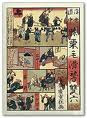
. sugoroku 双六 The Board Game Sugoroku .
- Introduction -
*****************************
Worldwide use
*****************************
Things found on the way
*****************************
HAIKU
ばらばらに花散る里や投扇興
barabara ni hana chiru sato ya toosenkyoo
scattered they fall,
the flowers of my hometown -
throwing fans competition
Ooshita Hideko 大下秀子
:::::::::::::::::::::::::::::::::::::::::::::::::::::::::::::::::::::::::::::::::::::::::::::::::::::
そのむかし十六むさし争ひし
sono mukashi juuroku musashi arasoishi
in olden times
the sixteen soldiers
fought bravely
Takizawa Iyoji 瀧澤伊代次
:::::::::::::::::::::::::::::::::::::::::::::::::::::::::::::::::::::::::::::::::::::::::::::::::::
碁に弱く十六むさし強きかな
go ni yowaku juuroku musashi tsuyoki kana
bad at the Go game -
Sixteen Soldiers is
my strong game
Ikenouchi Takeshi 池内たけし
*****************************
Related words
. Games and Toys in SPRING
. Games and Toys in SUMMER
. Games and Toys in AUTUMN
. Games and Toys in WINTER
.................................................................................
***** . NEW YEAR - KIGO for HUMANITY
. SAIJIKI - THE NEW YEAR
:::::::::::::::::::::::::::::::::::::::::::::::::::::::::::::::::::::::::::::::::::::::::::::::::::::
[ . BACK to DARUMA MUSEUM TOP . ]
[ . BACK to WORLDKIGO . TOP . ]
:::::::::::::::::::::::::::::::::::::::::::::::::::::::::::::::::::::::::::::::::::::::::::::::::::::


 Posts
Posts


3 comments:
Legends about Amanojaku
Gifu, 上宝村 Kamitakaramura, 双六 Sugoroku
Kobo Daishi 弘法大師 and Zaimoku-Iwa 材木岩 - Timber Rocks
Once Kobo Daishi came to Sugoroku village. He made a bet with the local Amanojaku that he would build a temple hall in one night. But the Amanojaku imitated the call of a rooster as a sign of morning and Kobo Daishi was deceived in thinking his time was up.
Kobo Daishi got so angry that he turned all the wood for the temple hall into stones and boulders. This is the origin of natural stone formation, looking like pieces of wood.
and
岩波橋 Iwanamibashi and Amanojaki 天の邪気 (あまのじゃき)
At 双六の岩波橋 the bridge Iwanamibashi at Sugoroku there is a rock formation looking like a game board for the game Sugoroku ( 双六の盤).
Once some Amanojaku collected rocks from a mountain in the West to make a board to play Sugoroku. The one who lost the game got angry and threw the bord far away, where it hit a stone cliff, dissolved into many small stones and is still now at the side of the river, called 賽の淵 Sai no Fuchi.
This is the origin of the name of this small village, Sugoroku.
and
天邪鬼と天人 Amanojaku to Tenjin
This is another version of the above, where Amanojaku and Tenjin played a game of Sugoroku. When Amanojaku cheated to win, Tenjin got angry and threw the board away. The dice they had used became the stone formation Sai ga Fuchi サイが渕 (same as the Sai no Fuchi above).
Once a gropu of professional gamblers made fun of this story and peed on the rocks.
Suddenly the weather turned wild, it began to snow and all the crops of the year were lost.
The gamblers were arrested, tortured and finally died of mental disorders.
.
http://gokurakuparadies.blogspot.jp/2015/06/amanojaku-legends.html
Legends about Sugoroku
35 to explore in the Yokai Database.
.
Funadama 船玉 / 船霊 / 船魂 and Sugoroku
https://japanshrinestemples.blogspot.jp/2017/09/funadama-funatama-boat-deity.html
.
Sugoroku
Sugoroku for Success in the First Sale of the New Year
(Hatsuakinai Shusse Sugoroku 初商出世双六)
.
https://heianperiodjapan.blogspot.com/2017/09/sugoroku-game-legends.html
.
Post a Comment