6/20/2007

Cucumber (kyuuri)

[ . BACK to WORLDKIGO TOP . ]

::::::::::::::::::::::::::::::::::::::::::::::::::::::::::::::::::::::::::::::::::::::::::::::::::::

Cucumber (kyuuri)

***** Location: Japan, worldwide
***** Season: Summer, see below
***** Category: Plant


*****************************
Explanation

kigo for early summer

cucumber seedlings, kyuuri nae 胡瓜苗


cucumber blossoms, kyuuri no hana
胡瓜の花 (きゅうりのはな)
..... hana kyuuri 花胡瓜(はなきゅうり)


In Japan, some small cucumbers are sold with the flower still sticking to the one end, so we can enjoy the contrast of the fresh green and yellow. The bright yellow flowers with their five petals look different in the morning and in the evening.

xxxxxxxxxxxxxxxxxxxxxxxxxxxxx

humanity kigo for all summer

cucumber (to eat), kyuuri 胡瓜 (きゅうり)

pickled cucumbers, kyuurizuke 胡瓜漬 (きゅうりづけ)
kyuurimomi, kyuuri momi 胡瓜揉(きゅうりもみ)
"cucumbers pickled with vinegar"


:::::::::::::::::::::::::::::::::::::::::::::::::::::::::::::::::::::::::::::::::::::::::::::::::::::


observance kigo for late summer

kyuuri fuuji きゅうり封じ / 胡瓜封じ cucumber service
(Kyuri Fuji)

It is in rememberance of Kobo Daishi, when he visited the memorial of Shotoku Taishi, and performed this ritual to ward off illness for the people.

CLICK for more photos

It has been performed at temple Zenkoji 善光寺 in Nagano, but came out of use in the Taisho period. Later this ceremony was revived aroud Showa 48 and is now performed on a sunday in late july. Everyone who comes had to bring a cucumber. The cucumber is the personification of this person and will bear all its illness and bad fortune. After the cucumber is purified in the ceremony, the person can take it home and eat it or burry it at home in his garden or throw it in a nearby river.

The cucumber resembles a standing human being, therefore it is used in this ritual.
When it is cut, it is round, like the wheel of the Buddhist law.

Also performed at the temple Renge-ji in Kyoto and others.


Gurken als Zeremonialgegenstand zur Abwehr von Krankheiten.


scorching heat -
a sacred cucumber helps
to survive


Gabi Greve, July 27, 2012


:::::::::::::::::::::::::::::::::::::::::::::::::::::::::::::::::::::::::::::::::::::::::::::::::::::


History

The cucumber is believed to be native to India, and evidence indicates that it has been cultivated in Western Asia for 3,000 years. The cucumber is also listed among the products of ancient Ur and the legend of Gilgamesh describes people eating cucumbers. Some sources also state that it was produced in ancient Thrace, and it is certainly part of modern cuisine in Bulgaria and Turkey, parts of which make up that ancient state. From India, it spread to Greece (where it was called "vilwos") and Italy (where the Romans were especially fond of the crop), and later into China.

The fruit is mentioned in the Bible (Numbers 11:5) as having been freely available in Egypt, even to the enslaved Israelites: We remember the fish, which we did eat in Egypt freely the cucumbers, and the melons, and the leeks, and the onions, and the garlick. The Israelites later came to cultivate the cucumber themselves, and Isaiah 1:8 briefly mentions the method of agriculture - The Daughter of Zion is like a shelter in a vineyard, like a hut in a field of melons, like a city under siege. The shelter was for the person who kept the birds away, and guarded the garden from robbers.

Read More
WIKIPEDIA


*****************************
Worldwide use


*****************************
Things found on the way


. Kappa the Water Goblin and Cucumbers 河童 .

*****************************
HAIKU


野は濡れて朝はじまりぬ花胡瓜  
no wa nurete asa hajimarinu hana kyuuri

the fields are wet
morning does not start without

cucumber flowers

Arima Kazuko 有馬籌子
(Tr. Gabi Greve)

xxxxxxxxxxxxxxxxxxxxxxxxxxxxx

生き得たる四十九年や胡瓜咲く 
ikietaru shijuukunen ya kyuuri saku   

I lived already
up to fortynine ...
cucumbers flower  


Hino Soojoo 日野草城
(Tr. Gabi Greve)

He caught the tuberculosis in 1946 and lived with this illness for a little more than 10 years.

WKD : Hino Sojo, Hino Soojoo 日野草城 (1901 - 1956)

xxxxxxxxxxxxxxxxxxxxxxxxxxxxx

胡瓜生(な)るしたかげふかき花のかず  
kuuri naru shitakagebukaki hana no kazu

in the dark underbrush
there are so many
flowers of the cucumber

cucumbers grow
in the dark underbrush -
what a number of flowers


Iida Dakotsu 飯田蛇骨
(Tr. Gabi Greve)


xxxxxxxxxxxxxxxxxxxxxxxxxxxxx

花胡瓜添えて男の料理かな
hana kyuuri soete otoko no ryoori kana

adding a cucumber flower
and here we are ...
a man's cooking


. . . . more haiku about cucumbers in Japanese :
© www.nhk.or.jp/haiku/

(Tr. Gabi Greve)

*****************************
Related words

***** Smelt, Osmerus mordax
"Cucumber Fish", kyuuri uo


*****
. sea cucumber (namako 海鼠) .
kigo for all winter


:::::::::::::::::::::::::::::::::::::::::::::::::::::::::::::::::::::::::::::::::::::::::::::::::::

6/19/2007

Fuchsia

[ . BACK to WORLDKIGO TOP . ]
::::::::::::::::::::::::::::::::::::::::::::::::::::::::::::::::::::::::::::::::::::::::::::::::::::

Fuchsia (fukushia)

***** Location: Japan, other areas
***** Season: Late Summer
***** Category: Plant


*****************************
Explanation

Fuchsia, fukushia フクシア

Trailing abutilon, tsuri uki soo 釣浮草(つりうきそう. ツリウキソウ)
"gourd-like plant", hyootan soo 瓢箪草(ひょうたんそう)
Fuschias

Fuchsia hybrida, Hybrid fuchsia

:::::::::::::::::::::::::::::::::::::::::::::::::::::::::::::::::::::::::::::::::::::::::::::::::::::


Fukushia (Fuchsia)
© LINDA INOKI / Japan Times


I tend my flowers for thee —
Bright Absentee! My Fuchsia's Coral Seams Rip —
while the Sower —
dreams —


From "I tend my flowers for thee"
by American poet Emily Dickinson (1830-86)


Emily Dickinson was a keen observer of plants, and here she zooms in on a tantalizing aspect of fuchsias — their luscious buds. My father used to grow lots of lovely fuchsias, and when I was a child I could not resist popping open the buds! Once open, the typically bi-colored flowers look like little ballerinas in pink and purple, or red and white dresses. There are about 100 species of wild fuchsias, and most are from Central and South America, but some are also found in Tahiti and New Zealand. Plant types range from a small ground-hugging forms to the impressive Tree Fuchsia of New Zealand, which grows up to 9 meters high. From just 10 or so species, more than 8,000 hybrids have been developed.

They are usually grown as tender or hardy shrubs for the garden, or as pot plants. However, the tough Fuchsia magellanica, a native of southern Chile, is often grown as a hedge in Ireland and Scotland. The genus was named after the German botanist Leonhard Fuchs (1501-66), although unfortunately he never saw the plants since fuchsias did not arrive in Europe until the late 18th century.

http://search.japantimes.co.jp/cgi-bin/fe20070620li.html


:::::::::::::::::::::::::::::::::::::::::::::::::::::::::::::::::::::::::::::::::::::::::::::::::::::

Fuchsia is a genus of flowering plants, mostly shrubs, which were identified by Charles Plumier in the late 17th century, and named by Plumier in 1703 after the German botanist Leonhart Fuchs (1501–1566). The English vernacular name Fuchsia is the same as the scientific name.


There are about 100–110 species of Fuchsia. The great majority are native to South America, but with a few occurring north through Central America to Mexico, and also several on New Zealand, and Tahiti. One species, Fuchsia magellanica, extends as far as the southern tip of South America on Tierra del Fuego in the cool temperate zone, but the majority are tropical or subtropical. Most fuchsias are shrubs from 0.2–4 m tall, but one New Zealand species, Kotukutuku (Fuchsia excorticata), is unusual in the genus in being a tree, growing up to 12–15 m tall.

Leonhart Fuchs was born in 1501. He occupied the chair of Medicine at the Tübingen University from the age of 34 until his death, on the 10th May 1566. Besides his medical knowledge, according to his record of activities which was extensive for the time, he studied plants. This was natural, for most of the remedies of the time were herbal and the two subjects were often inseparable.

More in here !
© Wikipedia

*****************************
Worldwide use


*****************************
Things found on the way


*****************************
HAIKU


Fuchsien im Garten -
wippende Ballettröckchen -
sie tanzen im Wind.


fuchsia in the garden
tutu teetering -
enjoy dancing in the wind


© Dietlinde Heider - Fuchsia - Swingtime


 Ballet Tutu : Skirt


*****************************
Related words

***** Tyrolean Lamp チロリアンランプ ‘Swing Bell’


Abutilon family. アブチロン
Red one: Abutilon megapotamicum

Abutilon means a medical substance that is helpful against diarrhea in animals.
The origin of this delicate flower is Brazil. It flowers from June to October.


city sunset
without a single firefly ...
the tyrolean lamps

Keiko Izawa, Japan

::::::::::::::::::::::::::::::::::::::::::::::::::::::::::::::::::::::::::::::::::::::::::::::::::::: 

[ . BACK to DARUMA MUSEUM TOP . ]
[ . BACK to WORLDKIGO . TOP . ]

:::::::::::::::::::::::::::::::::::::::::::::::::::::::::::::::::::::::::::::::::::::::::::::::::::::

Withered fields (kareno)

[ . BACK to WORLDKIGO TOP . ]
::::::::::::::::::::::::::::::::::::::::::::::::::::::::::::::::::::::::::::::::::::::::::::::::::::

Withered fields (kareno), withered plants/weeds

***** Location: Japan
***** Season: All winter / others see below
***** Category: earth / plants


*****************************
Explanation

A time when the voices of the autumn insects are heared no more, the leaves change color and dry, first frost can be seen.
These lonely landscape has been subject to poetry since the most olden times in Japan.

withered fields, kareno 枯野 かれの
a desolate [wintry] field
dürres Feld; ödes Feld; Einöde; Wildnis.

In Edo, this word referred to the road from Horiuchi 堀内 to Zooshigaya 雑司が谷.


withered plain, withered plains, karehara 枯原 (かれはら)
This can also refer to withered mountain slopes, in the sense of "withered open spaces".


karenohara 枯野原 a desolate field


person in a withered field, kareno bito 枯野人 (かれのびと)
inn in the withered fields, kareno yado 枯野宿 (かれのやど)
path in the withered fields, kareno michi 枯野道 (かれのみち)


. . . . .

The Japanese kareno 枯野 is sometimes translated as "withered moors"
withered "moors", karehara 枯原 (かれはら)

BUT

The English word "moor" (Moor in German) has a very special meaning:
a moor, a bog or peat bog, a fen.

quote
moor, moreland,
A bog, quagmire or mire is a wetland that accumulates acidic peat, a deposit of dead plant material—often mosses or, in Arctic climates, lichens.
© More in the WIKIPEDIA !


There are no "moors" in that biological sense in Japan.
It would be rendered in Japanese as

shitsugenchi, shitsugen 湿原地
or
areno, arechi 荒野, 荒れ地, wasteland, wilderness
or
numa 沼 marsh, swamp,
deitan numachi 泥炭沼地 peat bog


.....


dry and withered fields of the Kudara plain, kudara no
朽野 (くだらの, くだら野)

This expression has already been used in the Manyoshu Collction of Japanese poetry.
百済野 is another use of the kanji. Kudara was a placename of the plains north of the old capital of Nara (Osaka Plain), where many people from Kudara in Korea had settled.


kare ashiwara 枯蘆原(かれあしわら) withered reeds in the marsh


More see below.

.....


fields in winter, fuyuno 冬野 (ふゆの)
fuyu no no 冬の野(ふゆのの)
fuyu no hara 冬の原(ふゆのはら)plain in winter
path in the winter fields, fuyu-no michi 冬野道(ふゆのみち)

::::::::::::::::::::::::::::::::::::::::::::::::::::::::::::::::::::::::::::::::::::::::::::::::::::

kigo for late autumn

color of withered fields, kareno iro 枯野の色 (かれののいろ)

uragare, "dying of the little twigs and branches"
Withered tips, withered scene

uragareru うらがれる - 末枯れる

uragareno 末枯野(うらがれの)
no no uragare 野の末枯(ののうらがれ)
uragare no hara 末枯の原(うらがれのはら)
uragare no nobe 末枯の野辺(うらがれののべ)

uragare no noyama 末枯の野山(うらがれののやま)
fields and mountains are withered


*****************************
Worldwide use


*****************************
Things found on the way


*****************************
HAIKU


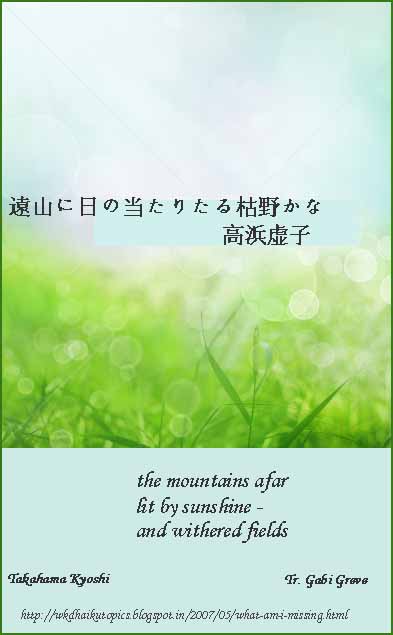
遠山に日の当たりたる枯野かな
tooyama ni hi no ataritaru kareno kana

Takahama Kyoshi 高浜虚子


tooyama ni hi-no atari-taru kareno kana
distant-hills on sun's basking withered-moor kana

On distand hills
the rays of the sun fall...
a withered moor.

Tr. Makoto Ueda

... ...


withered field...
distant mountains
lit by the sun


This haiku normally comes at the bottom of the popularity chart when shown to Western haiku poets. They simply do not think it is a good haiku. So much so that I have long wondered if they really understand haiku at all, or if Westerners will ever understand Japanese literary perceptions and sensibility in real terms.

Their belief that they are right is so strong that nothing can ever persuade them otherwise. It is indeed historically important to recognize that one of the masterpieces of Kyoshi has been so derided in the West.

Read more of this discussion !
© Susumu Takiguchi, July 2007


distant mountains
caught in the sun --
over the withered field


by Susumu Takiguchi, Floating Stone, 2003


Quote from
"Kyoshi, a Haiku Master"
by Susumu Takiguchi, World Haiku Review

"Toward the end of his life, Kyoshi reflected on his own haiku and mentioned that the winter scene depicted there had always been "keshiki" (landscape) which he saw "in his heart."........ the sun shining on the far mountains is the symbol of the optimistic side of life which Kyoshi never failed to mention as a counter-balancing force against its pessimistic side which Kyoshi was mature and resigned enough to accept."

... ... ...

the mountains afar
lit by sunshine -
and withered fields


From some Japanese online sources, I see that Kyoshi, who was 27 when he composed this haiku, leads us from the far background of the impressive Shikoku Mountain range with the majestic sacred mountain Ishizuchiyama in the sunshine to the foreground, within the season of winter. There is nothing artificial, contrived or mystical in this haiku, it is all real in front of his eyes ... and yet!
So the translation should reflect this order of seeing the landscape.

I think the mountain range in this scene is best expressed in plural, so are the withered fields. Having seen this landscape in Shikoku myself (although quite a few years after Kyoshi), I guess meadow in not appropriate for the scene here, neither is moor .
(And today, it might even be "withering suburbs", but that is a different matter.)

.................................................................................


Here is a similar simple mountain haiku by Kyoshi:

夏山やよく雲かゝりよく晴るゝ
natsuyama ya yoku kumo kakari yoku haruru

summer mountains -
sometimes in the clouds
sometimes in sunshine

WKD - Summer mountain


Many have asked me about this haiku and
What am I missing ?


Please feel free to add your translation version or thoughts about this haiku as a comment !


... ... ...


More translations


distant mountain
in the sun
beyond deserted field

Tr. Inaoka Michiko & Inaoka Tadayuki

... ... ...

The withered moor;
The sun shines
On the distant mountains.

Tr. Blyth

... ... ...

In the distant hills
A patch where sunlight touches
The withered meadows.

Tr. Donald Keene

... ... ... ... ... ... ... ... ...


明治33年(1900)11月25日,虚子庵
Written on November 25, 1900 at Kyoshi-An

Stepping out of his home, he could see the Shikoku mountains behind Dogo Hot Spring in Matsuyama Town. When the last sunshine hit these mountains, he felt some sort of comfort and security in his life. This is all he wanted to express in this haiku.
He did not want interpret this haiku as a talk about the change of seasons, the change of the human heart or anything personalized in this haiku, as his son tried to interpret it.

"No need to interpret it in the lines of "jinsei kan", an outlook of human life, or a generalization about the human condition. If you do that, it will only be "tsukinami", a mediocre haiku.
I only wrote about what was in front of my eyes!"


Artwork from Angelee Deodhar, India, 2013


This statement by Kyshi sounds like ultimate meaning of
SHASEI, sketching from nature, to me.

.....


Quote ..
Compiled by Larry Bole:
Read more translation versions HERE !


According to Nagayama Aya:

The radiant sun
Illuminates far off mountains ---
Oh, this withered field


"This haiku was written in 1900(Meiji 33) when Kyoshi was 26 years old.

This is one of Kyoshi's most famous masterpieces. It is considerd as a pivotal piece in which he established the haiku world of his own.

It is not difficult to understand this haiku. Far off mountains are seen across a withered field. The mountains are lit by the glow of the late afternoon sun whereas in the forground the winter field lies bleak and desolate.

This haiku deeply moves all who read it. Why this heartfelt reactions? Perhaps it is because the scene is so plainly described.
We, the readers, can clealy visualize what Kyoshi saw , and superimpose this image over our own memories.

The sun-lit mountains at the end of the bleak winter field may give hope and comfort to us, who are all travelers of life."


And Donald Keene says:
"Many critics consider [this haiku to be] Kyoshi's finest haiku... .
Yamamoto Kenkichi wrote of this poem, 'It is an astonishing verse that defies paraphrase. The language is quite ordinary, with nothing that call attention to itself, but the reader senses something of incalculable importance in this commonplace landscape. The combination of 'withered meadows' and 'distant hills' is not especially memorable in itself; the critical factor is the words 'a patch where sunlight touches' linking the nouns. This line, though not in the least extraordinary in itelf, makes both 'distant hills' and 'withered meadows' come alive.' "

Another thought by Larry:

Takiguchi does quote Kyoshi as saying he saw the landscape (keshiki) "in his heart...", so it wasn't only just what was "in front of [his] eyes!" although poets, like all of us, can contradictthemselves.

And poets aren't always aware of the unconscious meaning they may put into something they write; a meaning that others, being further away from the situation, are capable of seeing.

We have to ask, why did that particular landscape, on that particular day, resonate enough with Kyoshi to make him write a haiku about it, as opposed to other days he might have seen a similar landscape, and let it pass. What emotional and spirtual state was he in on that particular day?

I can understand Kyoshi not wanting to endorse any particular interpretation of the haiku, but are the interpretations this haiku has engendered too farfetched or too deep for this haiku to support? I don't think so.

In the same way, although Basho may never have intended the meanings his old pond/frog haiku has acquired from commentators, can the haiku support those meanings? I think it can, at least the simpler ones.

Larry Bole

.....

WKD: Takahama Kyoshi


More Japanese reference


Discussion of this haiku with members only.

:::::::::::::::::::::::::::::::::::::::::::::::::::::::::::::::::::::::::::::::::::::::::::::::::::::


The famous Death Haiku of Matsuo Basho 1694

旅に病んで夢は枯野をかけ廻る
tabi ni yande yume wa kareno o kakemeguru

falling ill while travelling -
in my dreams I am wandering
over withered fields

(Tr. Gabi Greve)

Read more translation verisons
HERE !


. Matsuo Basho 松尾芭蕉 - Archives of the WKD .


:::::::::::::::::::::::::::::::::::::::::::::::::::::::::::::::::::::::::::::::::::::::::::::::::::::


Issa and the Withered Fields
Tr. David Lanoue


遠方や枯野の小家の灯の見ゆる
enpô ya kareno no-goya no hi no miyuru

distant sight--
in withered fields
a little house's lamp


かくれ家に日のほかほかとかれの哉
kakurega ni hi no hoka-hoka to kareno kana

on a secluded house
the warm sun...
withered fields


片袖に風吹通すかれの哉
kata sode ni kaze fuki-tôsu kareno kana

through one sleeve
the wind passes...
withered fields


:::::::::::::::::::::::::::::::::::::::::::::::::::::::::::::::::::::::::::::::::::::::::::::::::::::

. Yosa Buson 与謝蕪村 in Edo .


蕭条として石に日の入枯野かな
shoojoo to shite ishi ni hi no iru kare no kana

Quietly, weakly,
into a rock the sunlight comes
in a withered field. 

Tr.Sawa & Shiffert


Bleak and lonely
the sun penetrates the rocks
in a withered field.

Tr. Addiss


so lost and lonely,
these rocks at sunset
in the withered fields . . .


Tr. Gabi Greve

Trying to interpret "ishi ni hi no iru" in a different angle.
The cut marker KANA is at the end of line 3.


秋の日の夕暮れが早くなってきました。

石に日の入: 「石に日が入る」
© kuuon.fya.jp/BUSON/
(further discussion in the comments)

..........................................................................


大徳(だいとこ)の糞ひりおはす枯野哉
. daitoko no kuso hiri-owasu kareno kana .

Buson observes a high priest shitting in a withered field.

..........................................................................


山を越す人に別れて枯野かな  
yama o kosu hito ni wakarete kareno kana

I part with a man
crossing the mountains
in the withered fields . . .  


The cut marker KANA is at the end of line 3.


..........................................................................


畠にもならでかなしき枯野哉 

むささびの小鳥はみ居る枯野哉 

石に詩を題して過る枯野哉 

三日月も罠にかゝりて枯野哉 

むささびの小鳥はみ居る枯野哉 

馬の尾にいばらのかかる枯野哉 

息杖に石の火を見る枯野哉

(TBA)

::::::::::::::::::::::::::::::::::::::::::::::::::::::::::::::::::::::::::::::::::::::::::::::::::::


sato-inu ya kareno no ato o kagi-ariki

a town dog
goes around the withered field
sniffing away


© Shiimoto Saimaro


xxxxxxxxxxxxxxxxxxxxxxxxxxxxxxxxxx


kareno yuku mottomo tôki hi ni hikare

journeying over
the withered moor,
drawn by the furthest light


Crossing barren fields
captivated by a light
far far away


© Takaha Shugyo
Tr. Hoshino Tsunehiko & Adrian Pinnington

xxxxxxxxxxxxxxxxxxxxxxxxxxxxx


uma shikaru koe mo kareno no arashi kana

The voice shouting at the horse
Is part of the storm
Of the withered moor.


Kyokusui
Tr. Blyth

..........................................................................


- - - - - Masaoka Shiki 正岡子規 - - - - -


大木の雲に聳ゆる枯野哉
taiboku no kumo ni sobiyuru kareno kana

A great tree
That rises up into the clouds,
On the withered moor.


tokorodokoro nabatake touki kareno kana

Here and there in the distance,
Fields of vegetables
On the withered moor.


旅人の蜜柑くひ行く枯野哉
tabibito no mikan kuiyuku kareno kana
Meiji 26

The traveller walks
Over the withered moor,
Eating an orange.

Tr. Blyth

. - Masaoka Shiki 正岡子規 - .


:::::::::::::::::::::::::::::::::::::::::::::::::::::::::::::::::::::::::::::::::::::::::::::::::::::


くだら野や無なるところを手向草
Kudarano ya nakunaru tokoro o tamukegusa


© www6.airnet.ne.jp/manyo

Now only the temple Daian-Ji 大安寺 is left in the village of Kooryoo-Choo 広陵町. The temple used to be called Kudara-Ji 百済寺 in memory of the Korean ancestors.

百済野の萩の古枝に春待つと居りし
鴬鳴きにけむかも


:::::::::::::::::::::::::::::::::::::::::::::::::::::::::::::::::::::::::::::::::::::::::::::::::::::


hiyu morotomo shinkoo kiete kareno no hi

The metaphors are
gone, and so is my faith . . .
sun over a moor.


Nakamura Kusatao

Metaphors and Haiku


*****************************
Related words


***** Withering in winter 冬枯れ fuyugare
kareyama 枯山(かれやま)withered mountain
karesono 枯園 (かれその) withered garden
..... kareniwa 枯庭(かれにわ)
niwa karuru 庭枯るる(にわかるる)garden is withering

kareki oroshi 枯木卸し(かれきおろし)cutting off withered branches

karezakura 枯桜(かれざくら) withered cherry tree
kareyamabuki 枯山吹 (かれやまぶき) withered kerria (yamabuki)
karefuyoo 枯芙蓉 (かれふよう) withered cotton rose
..... fuyoo karu 芙蓉枯る(ふようかる) cotton rose is withering

kareha 枯葉 (かれは) withered leaves
Les feuilles mortes

kusagare 草枯 (くさがれ) witherend plants/weeds
kusa karu 草枯る(くさかる)plants are withering
..... karekusa 枯草(かれくさ)


kareki koboku 枯木 withered trees


.................................................................................


na no kusa karu 名の草枯る (なのくさかる)
withering plants/weeds with a name

..... nagusa karu 名草枯る(なぐさかる)
migusa karu 水草枯る(みぐさかる)withering water plants

karekeitoo, kare keitoo 枯鶏頭(かれけいとう)
withered cockscomb

kareazami, kare azami 枯薊(かれあざみ)
withered thistles

karerindoo, kare rindoo 枯龍胆(かれりんどう)
withered gentian

karekaya, kare kaya 枯萱(かれかや)
withered rushes and reeds


bush clover withered (karehagi, kare hagi)
cotton rose withered (kare fuyoo)
fern withering (kare shida)
lawn is withered (kareshiba, kare shiba)
pampas grass withering (kare susuki, kare obana)
weeping fern withered (kare shinobu)
wild rice withered (kare makomo)
yellow mountain rose withered (kare yamabuki)

Plants in winter . . Kigo List


.................................................................................


***** Withered trees (kareki 枯木)...
bare branches (kare eda) and more

more kigo with KARE 枯


***** Rice paddies and related kigo


*****  Withered fields in the summer heat or drought
..... hiderida 旱田


kigo for late summer

.................................................................................


MORE KIGO about the wild fields, plains, moors (no, nohara)

. SAIJIKI ... category EARTH

. PLANTS IN WINTER - SAIJIKI


[ . BACK to WORLDKIGO TOP . ]
::::::::::::::::::::::::::::::::::::::::::::::::::::::::::::::::::::::::::::::::::::::::::::::::::::

6/18/2007

Daylily (kanzoo) - Lilies (yuri)

[ . BACK to WORLDKIGO TOP . ]
::::::::::::::::::::::::::::::::::::::::::::::::::::::::::::::::::::::::::::::::::::::::::::::::::::

Daylily, daylilies (kanzoo)


***** Location: Japan
***** Season: Late Summer
***** Category: Plant


*****************************
Explanation


flowers of the daylily, kanzoo no hana 
萱草の花 (かんぞうのはな)

yabukanzoo 薮萱草 (やぶかんぞう)
Hemerocallis fulva var. kwanso

wild daylilies, nokanzoo 野萱草(のかんぞう)
Hemerocallis longituba / ヘメロカリス

This flower is often grown in old temple compounds and already the subject of poetry in the Manyoshu collection.

.................................................................................


yuusuge, yuu suge 夕菅 (ゆうすげ) Thunberg's Daylily
lit. "evening Suge"
kisuge, ki suge 黄菅(きすげ) "yellow Suge"
Hemerocallis thunbergii. tall daylily, with yellow flowers


Nikkoo kisuge 日光黄菅 (にっこうきすげ) Amur Dailily
lit. "yellow Suge from Nikko"
zenteika 禅庭花(ぜんていか)"Zen garden flower"
setteika せっていか
Hemerocallis middendorffii


.................................................................................


. kinshinsai 金針菜 kind of day lily bud .


:::::::::::::::::::::::::::::::::::::::::::::::::::::::::::::::::::::::::::::::::::::::::::::::::::::


Daylilies
comprise the small genus Hemerocallis of flowering plants in the family Hemerocallidaceae. They are not true lilies which are Lilium in Liliaceae. The name Hemerocallis comes from Greek words for day and beauty. The flowers of most species open at sunrise and wither at sunset, possibly replaced by another one on the same stem the next day (some species are night-blooming). Daylilies are not commonly used as cut flowers for formal flower arranging, yet they make good cut flowers otherwise as new flowers continue to open on cut stems over several days.

Originally native from Europe to China, Korea, and Japan, their large showy flowers have made them popular worldwide. There are over 60,000 registered cultivars. Only a few cultivars are scented; some will rebloom later in the season, particularly if their developing seedpods are removed.

More is here
© WIKIPEDIA


© PHOTOS Gabi Greve


:::::::::::::::::::::::::::::::::::::::::::::::::::::::::::::::::::::::::::::::::::::::::::::::::::::


There are many other types of lilies in Japan and worldwide.


*****************************
Worldwide use

Mongolia


The one perfect thing for a girl of the remote Gobi was the flower- iris. I ran among iris on the steppe, swinging my skirt and chose the biggest virgin bloom of iris, blew my lips to get the sound “zen zen”.
White clouds of the blue iris flower, tried not lose their color, but my little fingers became white.
My mother told me that if you cut the tender spring iris blossoms the weather will turn dreary or rain will come.
I believed her because it rained when we cut them.
This is how I feel nature – mountains, clouds.


she blows on an iris -
clouds gather angrily
to the sound of 'zen zen'


Zaya Nergui

Mongolian people use iris flower in the treatment for gastric ulcer.

. WKD : Mongolia Saijiki .


*****************************
Things found on the way


*****************************
HAIKU


I gravitate to
Haiku for its brevity--
Hemerocallis

Michael R. Collings, USA

xxxxxxxxxxxxxxxxxxxxxxxxxxxxx


***************************************
Related words

***** Lily, yuri 百合 (ゆり)
kigo for early summer

mountain lily, yamayuri 山百合(やまゆり) Lilium auratum
golden-rayed [-banded] lily

tiger lily, "demon lily" oniyuri 鬼百合(おにゆり)
tengai yuri 天蓋百合(てんがいゆり)
ko oniyuri 小鬼百合(こおにゆり)Lilium leichtlinii
sugeyuri 菅百合(すげゆり)
star lily, "princess lily" himeyuri 姫百合(ひめゆり)
yellow princess lily, ki himeyuri
黄姫百合(きひめゆり)

"bamby lily", shika no ko yuri 鹿の子百合(かのこゆり) Lilium speciosum

"waterfall lily" takiyuri 滝百合(たきゆり)

sasayuri 笹百合(ささゆり)、sayuri さゆり bamboo lily
Lilium japonicum

sukashi yuri 透百合(すかしゆり)

Easter lily, teppoo yuri 鉄砲百合(てっぽうゆり)
Lilium longiflorum
sakuyuri さく百合(さくゆり) Lilium platyphyllum
kurumayuri 車百合(くるまゆり) Lilium medeoloides
Takeshimayuri 竹島百合(たけしまゆり)Lilium hansonii

white lily, shirayuri 白百合(しらゆり)
red lily, beniyuri 紅百合(べにゆり)


fragrance of the lily, yuri no ka 百合の香(ゆりのか)


kigo for late summer

kuroyuri, kuro yuri 黒百合 (くろゆり) "black lily"
Fritillaria camschatcensis

............................................


The genus Lilium are herbaceous flowering plants normally growing from bulbs, comprising a genus of about 110 species in the lily family, Liliaceae. They are important as large showy flowering garden plants, and in literature. Some of the bulbs have been consumed by people. The species in this genus are the true lilies, while other plants with lily in the common name are related to other groups of plants.
... more in the WIKIPEDIA


しんしんとゆりの咲けり鳴雲雀
shin-shin to yuri no saki keri naku hibari

quietly the lilies
have bloomed...
a skylark sings

Tr. Lanoue

. WKD : Kobayashi Issa 小林一茶 .

.............................................................................


ゆり咲や大骨折って雲雀鳴く
yuri saku ya oo-bone otte hibari naku

a skylark
among blooming lilies
sings its heart out

Tr. Chris Drake

This summer hokku is from the 4th month (May) of 1810, when Issa was traveling around in the area just east of Edo. A lark is singing as strongly as it can, and Issa is impressed by its sound. With a touch of humor Issa says the small-boned lark is "breaking a big bone," a metaphorical idiom that means to make a great effort or to do one's best for someone else. By using the idiom for a small bird, Issa draws attention to its literal meaning, and the vowels and two b's help suggest how big and resounding the lark's song is and how unreservedly it wants to do its best for the lilies.

Perhaps the shape of the lilies suggests they are listening intently to the lark.
The hokku before this one in Issa's diary also suggests this:

kyoo kara no nembutsu kiki-kiki yuri no hana

listen, listen, lilies
to all the Buddha names
from today on


The lilies seem to be growing near a temple. Summer retreats (ge) begin in the middle of the 4th month, and for the next three months the lilies in the area will hear the name of Amida Buddha chanted many times with great devotion. Issa asks them to listen carefully and respectfully day after day and learn from each chanted name about Amida and the Pure Land. Issa obviously believes the Pure Land is open to the lilies as well. Since the hokku about the skylark follows this one, Issa may be assuming that the passionate bird is singing Amida Buddha's name in its own lark language.

Chris Drake


しんしんとゆりの咲けり鳴雲雀
shin-shin to yuri no saki keri naku hibari

in deep silence
lilies blooming --
a skylark sings

Tr. Chris Drake

This summer hokku was written in the 4th month of 1810, when Issa was traveling in the area east of Edo. It's written in the objective Edo manner, a style whose influence helps keep Issa's later autobiographical style objectively subjective and thereby increases its power. The word shin-shin, written phonetically by Issa, is often written 深々, with characters meaning 'deep, deep,' and it suggests a hushed, profound silence and stillness. The funnel-like exfoliating shape of the lilies perhaps seems to Issa to be a visible analog of the deep silence and stillness in what seems to be a secluded spot on the edge of a field or a wood. The silence makes the sudden clear, sharp cadences of the skylark even more piercing.

The next, very interesting hokku in Issa's diary reverberates with the above hokku:

neru ushi wa yuri no kokoro ni kanaubeshi

how it delights
the hearts of the lilies --
a sleeping cow


The word translated as cow is written by Issa with 午, the character for the Chinese zodiacal horse (not the character used for physical horses), but various editors are in agreement that this represents a small slip of the brush for 牛, cow. The lilies seem to sense a profound silence, peacefulness, and stillness in the cow sleeping nearby. They clearly seem to feel something, according to Issa, that attracts and delights them (kokoro ni kanau) and makes them feel the sleeping cow is a kindred spirit. It is not strange or unusual for Issa to attribute kokoro or hearts/minds to the lilies, since in Japanese Buddhism it was commonly assumed that plants and trees had some sort of consciousness and could achieve buddhahood, an assumption that still remains today to a certain extent. Hearts/minds has no number in Japanese, but I use the plural since the lilies are plural. If one believes all beings share a single heart/mind, then the singular might be appropriate.

Chris Drake


. Onomatopoetic Words used in Haiku .


::::::::::::::::::::::::::::::::::::::::::::::::::::::::::::::::::::::::::::::::::::::::::::::::::::: 


Kannon-Lily -
raindrops sparkling
in the night


© Gabi Greve, 2004
With more photos !
Stargazer Lilies


:::::::::::::::::::::::::::::::::::::::::::::::::::::::::::::::::::::::::::::::::::::::::::::::::::

yuri matsuri 百合祭(ゆりまつり) lily festival
. Saikusa matsuri 三枝祭 Saikusa Festival
at shrine Saigawa in Nara, June 17
with Lilium japonicum, sasayuri ささゆり (笹百合)
bamboo lily
nanaotome yuri 七媛女百合, nana otome yuri

:::::::::::::::::::::::::::::::::::::::::::::::::::::::::::::::::::::::::::::::::::::::::::::::::::


***** Licorice, liquorice, kanzoo 甘草 (かんぞう)
kigo for early summer

"forget-it-plant" wasuregusa 忘草 / 忘れ草 (わすれぐさ)(also used for the daylily)
"sweet plant", amaki あまき、amakusa あまくさ
fam. Glycyrrhiza


Often used in traditional Chinese medicine.


忘れ草菜飯に摘まん年の暮
wasuregusa nameshi ni tsuman toshi no kure
. Food haiku by Matsuo Basho 松尾芭蕉 .
Basho had a weak stomach and often used herbal medicine.


candy corn
and licorice for children
in costumes . . .


(traditional colors for Halloween: orange and black)

- Shared by Elaine Andre -
Haiku Culture Magazine, 2013


:::::::::::::::::::::::::::::::::::::::::::::::::::::::::::::::::::::::::::::::::::::::::::::::::::::


kigo for mid-spring

baimo no hana 貝母の花 (ばいものはな)
flower of the Amigasa lily

amigasa yuri 編笠百合(あみがさゆり)
haruyuri, haru yuri 春百合(はるゆり)spring lily
hatsu yuri 初百合(はつゆり)first lily
hahakuri 母栗(ははくり)"mother chestnut"
Amigasa-Lilie
Fritillaria verticillata

Originated in China.


::::::::::::::::::::::::::::::::::::::::::::::::::::::::::::::::::::::::::::::::::::::::::::::::::::


kunshiran 君子蘭 (くんしらん) scarlet Kaffir lily
lit. "gentleman"s orchid"
oobana kunshiran 大花君子蘭(おおばなくんしらん)Kaffir lily with large blossoms
fam. Clivia

::::::::::::::::::::::::::::::::::::::::::::::::::::::::::::::::::::::::::::::::::::::::::::::::::::


kanoko yuri 鹿の子百合 Japanese lily

doyoo yuri 土用百合 "lily on the dog day in summer"
tanabata yuri 七夕百合 lili during the star festival
Lilium speciosum
a lily native to Japan. It grows up to around 1.5 m in height. The flowers are white to pink in colour, and strongly scented. It is later flowering than most other species.
© More in the WIKIPEDIA !

.................................................................................


夕闇やかのこ斑のゆりの花
yuuyami ya kanoko madara no yuri no hana

at dusk
these dappled
lilies


Kobayashi Issa 一茶

Comment by Chris Drake :

Issa isn't watching a fawn. "Fawn-spotted" means dappled or mottled. In a famous example, the ancient poet Narihira wrote the following waka about Mt. Fuji being "fawn-spotted" by snow in summer in Ise Tales 9 (Shinkokinshuu no. 1616):

Fuji, a mountain
knowing no seasons --
what time does it think
it is now, with its
patches of fallen snow?


"Patches" here is literally "fawn-spotted." Likewise Japanese tie-dyeing is literally "fawn- spotted shibori."

As an adjective, "fawn-spotted" doesn't refer only to white spots but to any dappling in which the background and spots are of clearly different colors or of different shades of the same color. In Issa's hokku, the lilies could be of any color, though white, magenta, orange (tiger lilies), and yellow seem to be the most common colors in Japan. Since there isn't much available light, Issa may be evoking the flowers as "floating" above the ground, which is already almost dark. The spots dappling the lilies perhaps make them seem porous and liminal, halfway between this world and another. This hokku resembles Issa's hokku about the lotus flowers at dusk below a willow tree and his hokku about the rapeseed flowers on a rainy night, although this hokku is less explicitly spiritual. Still, it has a border-light spiritual power of its own.

Issa is referring to spotted lilies in general (kanoko-madara no), not just to kanoko-yuri. There are many different kinds of spotted lilies that grow in Japan. You can see various kinds in old Edo books or with Japanese Google at
鹿の子まだらのユリ .
Kanoko-yuri are found only on Shikoku and Kyushu. Therefore it would be impossible for Issa in eastern Honshu to be looking at that variety of spotted lily.


::::::::::::::::::::::::::::::::::::::::::::::::::::::::::::::::::::::::::::::::::::::::::::::::::::


. Plants in Spring - SAIJIKI .


::::::::::::::::::::::::::::::::::::::::::::::::::::::::::::::::::::::::::::::::::::::::::::::::::::


Amaryllis (amaririsu)


[ . BACK to WORLDKIGO  TOP . ]
:::::::::::::::::::::::::::::::::::::::::::::::::::::::::::::::::::::::::::::::::::::::::::::::::::::

Jasmine

[ . BACK to WORLDKIGO TOP . ]
::::::::::::::::::::::::::::::::::::::::::::::::::::::::::::::::::::::::::::::::::::::::::::::::::::

Jasmin, Jasmine (jasumin)

***** Location: Japan, other areas
***** Season: Late Summer
.....................(more see below)
***** Category: Plant


*****************************
Explanation

Jasmin, matsurika 茉莉花 (まつりか)
..... sokei 素馨(そけい)
..... jasumin ジャスミン

American Jasmin アメリカジャスミン

Jasminum officinale is the most common one referred to in haiku. It is the national flower of Pakistan. In Persian, it is originally called "yasmin".

xxxxxxxxxxxxxxxxxxxxxxxxxxxxx


:::::::::::::::::::::::::::::::::::::::::::::::::::::::::::::::::::::::::::::::::::::::::::::::::::::


Jasmine or Jessamine (Jasminum)
is a genus of shrubs and vines in the olive family (Oleaceae), with about 200 species, native to tropical and warm temperate regions of the Old World. The majority of species grow as climbers on other plants or on structures. The leaves can be either evergreen or deciduous, and are opposite in most species; leaf shape is simple, trifoliate or pinnate with up to nine leaflets.

Jasmine flowers are generally white, although some species have yellow flowers. Unlike most genera in the Oleaceae which have four corolla lobes ("petals"), jasmines often have five or six lobes. They are often strongly and sweetly scented. Flowering is in spring or summer in most species, but in a few species, notably J. nudiflorum, in winter on the bare branches of this deciduous species.

Jasminum sambac is also the National Flower of Indonesia, where it is known as "Melati", and of the Philippines, where it is known as "Sampaguita". In Indonesia (especially the island of Java), it is the most important flower in wedding ceremonies for ethnic Indonesians. Jasminum officinale is the national flower of Pakistan, where it is known as the "Chameli" or "Yasmine". In Sanskrit it is called Mallika. Jasmine is cultivated at Pangala, in Karnataka, India, and exported to Middle East countries.

In Thailand, jasmine flowers are used as a symbol of the mother.

J. fluminense is an invasive species in Hawaii, where it is sometimes known by the inaccurate name "Brazilian Jasmine". J. dichotomum is also invasive in Florida.

Read more HERE !
© WIKIPEDIA


:::::::::::::::::::::::::::::::::::::::::::::::::::::::::::::::::::::::::::::::::::::::::::::::::::::


winter jasmine, Jasminum nudiflorum
kigo for winter

. . . CLICK here for Photos !


*****************************
Worldwide use

If you find jasmine blossoms in spring in your area, then this is a kigo for your spring.
Let us know the area and your haiku about it, please.


:::::::::::::::::::::::::::::::::::::::::::::::::::::::::::::::::::::::::::::::::::::::::::::::::::::


Florida, USA


the arid voice of spring
lingering in bamboo
wild jasmine


- Shared by Sandi Pray -
Joys of Japan, 2012


Starry Wild Jasmine - Jasminum multipartitum

:::::::::::::::::::::::::::::::::::::::::::::::::::::::::::::::::::::::::::::::::::::::::::::::::::::


Yemen

kigo for summer

... today’s Yemenites seem to prefer bright blossoms and the heavy sweetness of jasmine. Street vendors sell jasmine garlands along with khat (a narcotic pinch between cheek and gum). At commencement exercises, it’s become customary to shower the graduates with jasmine petals, much lovelier than a flurry of mortar boards.

Read more HERE
... www.humanflowerproject.com


crickets
in wild jasmine..
night chat


breath taking
she beads blooms ..
jasmine necklace


In camel tracks
jasmine petals..
singing garland vendor


Jasmin garlands are also use as wedding decorations. If you see a lady preparing a garland, you would immediately ask her: "To whose wedding are you invited?"

Heike Gewi, Yemen, January 2008


*****************************
Things found on the way


*****************************
HAIKU


modern haiku
one more jasmine bloom
lights up the trellis


paul t conneally, UK

A Tribute to Robert Spiess
(1921 - 2002)


xxxxxxxxxxxxxxxxxxxxxxxxxxxxx

maybe
she is flying over Alaska
faint scent of jasmine

YASUOMI KOGANEI, JP

možda
ona leti preko Aljaske
slab miris jasmina

Tr. Karolina Riječka

:::::::::::::::::::::::::::::::::::::::::::::::::::::::::::::::::::::::::::::::::::::::::::::::::::::

Compiled by Larry Bole


"jasmine"
the sound itself
is scented


Larry Bole


...


jasmine
we arrange our chairs
to face upwind


Ferris Gilli


...


a little escape
from the world and its affairs -
the scent of jasmine

Tom Tico
The Heron's Nest, Volume VII, Number 4: December, 2005


...


morning haze
she tries jasmine
in her hair


Maria Steyn
The Heron's Nest, Volume III, Number 10: December, 2001

:::::::::::::::::::::::::::::::::::::::::::::::::::::::::::::::::::::::::::::::::::::::::::::::::::::

moonlight
drifting through darkness
jasmine


hortensia anderson


:::::::::::::::::::::::::::::::::::::::::::::::::::::::::::::::::::::::::::::::::::::::::::::::::::::


slightly dizzy,
I collect a jasmine -
evening arrived


Alex Serban, Romania

::::::::::::::::::::::::::::::::::::::::::::::::::::::::::::::::::::::::::::::::::::::::::::::::::::: 


first moist breeze -
fragrance of Jasmine reaches
my dinner table


- Shared by Surmeet Maavi, India -
Joys of Japan, 2012


:::::::::::::::::::::::::::::::::::::::::::::::::::::::::::::::::::::::::::::::::::::::::::::::::::::


a long journey ...
the lingering scent
of juhi flowers


juhi - Jasminum auriculatum
The flower is held sacred to all forms of Goddess Devi and is used as sacred offerings during Hindu religious ceremonies.
source : www.flowersofindia.ne


- Shared by Sandip Sital Chauhan -
Joys of Japan, July 2012


*****************************
Related words

***** . Jasminum sambac - Sampaguita .
Philippines

***** . Parijaat blossoms - Night Jasmine"
.
Nyctanthes arbor-tristis
India


[ . BACK to DARUMA MUSEUM TOP . ]
[ . BACK to WORLDKIGO . TOP . ]
:::::::::::::::::::::::::::::::::::::::::::::::::::::::::::::::::::::::::::::::::::::::::::::::::::::

6/17/2007

Goose, geese (kari)

[ . BACK to WORLDKIGO TOP . ]
::::::::::::::::::::::::::::::::::::::::::::::::::::::::::::::::::::::::::::::::::::::::::::::::::::

Goose, geese (kari, gan)

***** Location: Japan, worldwide
***** Season: various, see below
***** Category: Animal


*****************************
Explanation


............................... kigo for late autumn

goose, geese, kari 雁 (かり)
..... gan がん
..... かりがね , カリガネ" lesser white-fronted goose、Anser erythropus, flying in "chevron shape"
This refers to the wild geese.

first goose, first geese, hatsukari 初雁(はつかり)

white-fronted goose, magan 真雁(まがん)
hishikui 菱喰(ひしくい)

"sake face goose", sakatsuragan 酒顔雁(さかつらがん)

small goose, kogarigane 小雁(こかりがね)
black goose, kokugan 黒雁(こくがん)
gray goose, hai irogan 灰色雁(はいいろがん)


Shijuu karagan 四十雀雁(しじゅうからがん)

"swamp goose", numa taroo 沼太郎(ぬまたろう)
nogan 鴇(のがん)

"mountain turkey", yama shichimenchoo 山七面鳥(やましちめんちょう)
another name for the
wild goose, nogan 野雁(のがん)
"Princess goose", himegan 姫雁(ひめがん)


row of geese, gan no retsu 雁の列(かりのれつ)
formation of geese flying, flight of geese
. . . CLICK here for Photos !


"geese like a pole", kari no sao 雁の棹(かりのさお)
one row of geese, line of geese, ganji 雁字(がんじ)
..... ganjin 雁陣(がんじん)、gankoo 雁行(がんこう)


sound of the geese, kari ga ne 雁が音(かりがね)

geese crossing over, kari wataru 雁渡る(かりわたる)
geese coming, kari kitaru 雁来る(かりきたる)、
geese in the sky, amatsukari 天津雁(あまつかり)
geese in the clouds, kumoi no kari 雲井の雁(くもいのかり)
The geese come to Japan in autumn and spend the winter here.


geese in a small field, oda no kari 小田の雁(おだのかり)
a flock of geese in a field

goose falling down, rakugan 落雁(らくがん)
ill goose, byoogan 病雁(びょうがん) -


病雁の夜寒に落ちて旅寝哉
. byoogan no yosamu ni ochite tabine kana .
Matsuo Basho 松尾芭蕉 - more hokku about - kari 雁 goose
yamukari 病雁(やむかり)used by Basho


:::::::::::::::::::::::::::::::::::::::::::::::::::::::::::::::::::::::::::::::::::::::::::::::::::::

............................... kigo for winter

"white goose", hakugan 白雁(はくがん)
Snow Geese
Anser caerulescens

geese in the cold, kangan 寒雁
Geese in winter, fuyu no gan 冬の雁 fuyu no gan

:::::::::::::::::::::::::::::::::::::::::::::::::::::::::::::::::::::::::::::::::::::::::::::::::::::


............................... kigo for mid-spring

. ganburo 雁風呂 がんぶろ "bath for the wild geese" .
..... kari kuyoo 雁供養(かりくよう) memorial service for wild geese
In Tsugaru, Aomori

.................................................................................


............................... kigo for late spring

spring geese, haru no kari 春の雁
nokoru kari 残る雁(のこるかり)geese still left over


geese going back home, kigan 帰雁
lit. "geese going home"
The geese are leaving Japan now and go back to Northern regions.

good by for the geese, kari no wakare 雁の別れ(かりのわかれ)

geese still here, nagori no kari 名残の雁(なごりのかり)
..... imawa no kari いまわの雁(いまわのかり)
leaving geese, yuku kari 行く雁(ゆくかり)

geese returning home, departing geese
..... kaeru kari 帰る雁(かえるかり)
They are off to their Northern breeding habitats.


:::::::::::::::::::::::::::::::::::::::::::::::::::::::::::::::::::::::::::::::::::::::::::::::::::::

Goose (plural geese, male gander(s))
is the general English name for a considerable number of birds, belonging to the family Anatidae. This family also includes swans, most of which are larger than geese, and ducks, which are smaller.


Goose in its origins is one of the oldest words of the Indo-European languages (Crystal), the modern names deriving from the proto-Indo-European root, ghans, hence Sanskrit hamsa (feminine hamsii), Latin anser, Greek khén etc.

In the Germanic languages, the root word led to Old English gos with the plural gés, German Gans and Old Norse gas. Other modern derivatives are Russian gus and Old Irish géiss; the family name of the cleric Jan Hus is derived from the Czech derivative husa.

In non-technical use, the male goose is called a "gander" (Anglo-Saxon gandra) and the female is the "goose"; young birds before fledging are known as "goslings". A group of geese on the ground is called a gaggle; when flying in formation, it is called a wedge or a skein.

Read more in the © WIKIPEDIA

*****************************
Worldwide use


Canada, North America

Geese heading north
kigo for spring

Geese heading south
kigo for autumn

Canadian SAIJIKI Canadiens


:::::::::::::::::::::::::::::::::::::::::::::::::::::::::::::::::::::::::::::::::::::::::::::::::::

Germany

Gans,
ach du dumme Gans!


Eine sehr bekannte und häufig angewandte Redensart, um die geistige Beschränktheit weiblicher Personen zu bezeichnen. Die Gans steht bei uns ebenso allgemein in dem Rufe der Dummheit wie der Esel. Auch führt sie den Namen Alheit = Adelheit, abgekürzt Alke. Man leitet diesen Namen ebenfalls aus der Dummheit und Geschwätzigkeit her, durch welche die Gans charakterisiert wird.

More is here :
© www.operone.de

In other cultures, we have other associations with these animals.
For example the
"The Golden Goose" in Grimms Fairy Tales.
and Mother Goose.


:::::::::::::::::::::::::::::::::::::::::::::::::::::::::::::::::::::::::::::::::::::::::::::::::::

Ireland

Light-bellied Brent Goose
Branta bernicla hrota

Winter migrant from high-Arctic Canada. Most occur in Ireland between October and April.
Mostly found on coastal estuaries during the autumn and early winter, and also on grasslands from mid-winter, until departure for the breeding grounds begins in late April.
source : www.birdwatchireland.ie


pale bellies..
almost time
for goodbyes


- Shared by John Byrne -
Haiku Culture Magazine , 2013


*****************************
Things found on the way


The snow goose need not bathe to make itself white.
Neither need you do anything but be yourself.


Lao-Tzu

:::::::::::::::::::::::::::::::::::::::::::::::::::::::::::::::::::::::::::::::::::::::::::::::::::

Goosie goosie gander where shall I wander,
Upstairs, downstairs and in my lady's chamber
There I met an old man who wouldn't say his prayers,
I took him by the left leg and threw him down the stairs.

Obscure morality Nursery Rhyme
© www.famousquotes.me.uk


*****************************
HAIKU


. Kobayashi Issa 小林一茶 in Edo .

the rear goose--
well, well
a sore foot


ato no kari yare-yare ashi ga itamu yara
跡の雁やれやれ足がいたむやら

by Kobaylshi Issa, 1812

Shiniji Ogawa notes that ato in this haiku, though it is spelled with the kanji for "footprint," in fact means "rear": ato no kari = "rear goose."


来た雁や片足上て一思案
kita kari ya kata ashi agete isshian

the newly arrived goose
lifts one leg...
deep meditation

Tr. David Lanoue


. Why Ducks Sleep Standing On One Leg .


念仏がうるさいとてや雁帰る
nenbutsu ga urusai tote ya kari kaeru

even if their Amida prayer
is so noisy today -
geese departing

Tr. Gabi Greve

I feel the parting geese and their honking are the "urusai nenbutsu"
that Issa hears in the fields.
To him the honking before departure sounds like the noisy nembutsu Amida prayer done by the geese to pray for their safe return home


nenbutsu, nembutsu : 南無阿弥陀仏
. Namu Amida Butsu, the Amida Prayer .


.............................................................................


夕月に尻つんむけて小田の雁
yuuzuki ni shiri tsunmukete oda no kari

in a small paddy
wild geese point their tails
at the evening moon

Tr. Chris Drake


This hokku was written at the end of the 8th month (early October) in 1812.
Wild geese have flown south to Japan for the winter, and a group is now in a small dry rice paddy that's mostly empty following the recent rice harvest. As the geese bend over and forage in the grasses and stubble that remain, their tail feathers point up toward the moon. In Issa's time an evening moon (yuuzuki) was usually a waxing moon going down in the west late in the afternoon or in the twilight, so the tails of the geese are pointing upward and westward.
Perhaps Issa feels it's uncanny that the tails of the geese are pointing in the direction of the Pure Land even though they don't seem to be aware of it.

Chris Drake

.............................................................................


出る月に門田の雁の行儀哉
deru tsuki ni kadota no kari no gyoogi kana

at moonrise geese
in the field by the gate
remember their manners

Tr. Chris Drake

This autumn hokku was written in the 7th month (August) in 1810, when Issa was traveling around in the area to the east of Edo. The gate does not belong to a typical farmhouse, and this is no ordinary rice paddy. Most paddies were located some distance from the farmer's house, but this paddy is located directly in front of the large front gate of a temple or shrine or the gate of a mansion owned by a rich landlord or samurai, and it is choice land, probably with high yields.

Wild geese usually return to the Edo-Tokyo area in October and stay until spring, but Issa is writing in August, so this seems to be a hokku based on a memory. In October the paddies have been drained and harvested, and the wild geese go through the now dry fields looking for straw and stray grains of rice. They have been enjoying themselves and making quite a racket in the dark, but when the moon rises they realize they can be seen, and they suddenly become more polite, presumably quieter and less conspicuous. Issa seems amused, and the geese apparently remind him of humans who suddenly become restrained and polite when they visit a temple or pass by the mansion of a powerful person.

Chris Drake

.............................................................................


おりよ雁一もくさんに我前へ
oriyo kari ichimokusan ni waga mae e

geese, hurry down
as fast as you can
right here to me

Tr. Chris Drake


This hokku was written in the 9th month (October) of 1819, the year Issa recorded in Year of My Life (Oraga haru).
Looking up, Issa sees another line of wild geese flying south for the winter. Since wild geese fly south to Japan in order to winter in warm places, they tend to fly right over Issa's hometown or stay there only for a short time, since it's on a high plateau that's very cold and snowy in the winter. To get their attention, Issa addresses them strongly. It's almost as if he's shouting up at the birds in the sky as they pass over him. Don't look anywhere else -- look straight ahead and land right here in front of me as quickly as you can. Do the birds feel the depth of his desire to meet them?

Chris Drake

.............................................................................


行雁やきのふは見へぬ小田の水
yuku kari ya kinoo wa mienu oda no mizu

the geese go north --
today they see rice fields
full of water

Tr. Chris Drake

This spring hokku was written on 1/21 (March 2) of 1804, when Issa was living on the outskirts of the city of Edo. All winter wild geese from Siberia have been foraging the dry, stubble-filled rice paddies in this farm village near Edo. Even though the area gets a bit of snow in the winter, the geese find enough food to stay alive. However, the local farmers have today turned their rice fields into shallow ponds so they can begin to prepare them for rice planting in late May or early June, and suddenly the geese have lost their main places to forage and their favorite places for hanging out. They seem to get the message and set out the same day for their northern summer home.

Because there is a cutting word at the end of the first line, no viewers are explicitly connected to the verb in the second line. This is normal procedure in Japanese poetry, in which syllable space is limited and suggestion is a main means of reference. Usually this simply indicates that the author feels there are enough details in the waka or hokku to allow the reader to infer who is doing what. In Issa's hokku, "weren't visible" implies that yesterday neither humans nor birds could see any wet paddies in the area, but today they all can see them. Since the first line makes the returning geese the focus of the hokku, however, the most important eyes are those of the birds. It's the geese who are shocked to see their temporary winter foraging grounds now covered by water, and it's the same geese who leave (yuku) for the north the very same day. The two verbs are linked: it's what the geese see that makes them head back north. To the villagers and to Issa, the now wet fields are a normal change and not a special sight. Still, to Issa the sudden departure of the flock of geese is no doubt a moving experience, and in the previous hokku in his diary he wistfully says that it has at last become time for the wild geese to return north and leave the area outside his door.

Chris Drake

.............................................................................


帰る雁我をかひなき物とやは
kaeru]kari ware o kainaki mono to yo wa

returning geese,
have you completely
given up on me?

Tr. Chris Drake

This hokku was written in the 2nd month (March) of 1810, when Issa was traveling around visiting students in the area east of the city of Edo. It seems to be a humorous hokku using personification and tinged with longing. The wild geese are all leaving Japan now and flying back to their summer homes in the north, and not one stops to say goodbye to Issa. Writing of the geese as if they were his friends, Issa asks them a question with an ending, ya wa, that is usually ironic, and refers to himself as useless, a failure, and a good-for-nothing even though he is able to at least survive by teaching haikai and has gained enough confidence in his own haikai to begin his Seventh Dairy at New Year's in 1810. It seems likely that Issa's strongest sense of failure at this time was his continuing inability to move into his half of his natal house in his hometown.

After negotiating hard, he finally signed an agreement with his half brother in 1808 to split half his father's property, but in reality his brother and stepmother continued to refuse him entrance to his half of his father's house. Yet Issa was trying to do something about it. About three months after this hokku was written, Issa made still another trip to his hometown, so he was probably planning the trip at the time the hokku was written. With irony Issa seems to playfully scold the returning geese for giving up on him too soon and leaving him behind, since he is planning to return to his hometown again and again until he, too, can truly call it home.

Chris Drake

.............................................................................

門口の行灯かすみてかへる雁
kado-guchi no andon kasumite kaeru kari

by the door
the lamp now dim --
geese leaving for home

Tr. Chris Drake

This hokku is from lunar 11/17 (Dec. 30) in 1803, when Issa was visiting Fukawa, a river town northeast of Edo, just beyond the northern border of the wide Katsushika District in Shimōsa Province. Perhaps some wild geese wintering in Fukawa reminded Issa of what he felt when geese were leaving Japan for the north country the previous spring.

The lamp in the second line or measure of the hokku is one that has a wooden base with a square or round frame extending up above it covered with translucent Japanese washi paper that keeps wind from blowing out the flame. Often such lamps had a handle at the top for portability. Since this is a night hokku, the lamp may be placed just inside the front door of a house. Or is it perhaps in an inn? The lamp might possibly be placed just outside the door if there is a gathering of people there. The verb in the second line, kasumite, also means 'to mist,' but in this hokku it seems more likely to mean 'be dim, faint,' a meaning that was more common in Issa's time than it is in contemporary Japanese. The hokku following this one in Issa's diary is a variant of the present hokku, and it has the light of a lamp in a stable growing dim as geese pass by outside, and the hokku preceding this one has people eating in a room lit by lamplight while geese leave on their journey to the north.

Doors, stables, and eating could suggest either people returning after a long day outside or people getting up very early and getting ready for a day's work, or for continuing on a journey. In either case, it was common to get up well before dawn in order to be able to make use of every possible hour of daylight. Since this is a spring verse, I take it to suggest a predawn time when people are getting up and beginning to think about the coming day. Outside a flock of wild geese has been excited by the moon or by the first light of dawn, and it passes by noisily above the house. The light in the lamp is dim now, but no one refills it with lamp oil since dawn is not far off. Perhaps people are going out the door and getting ready for work or for a trip as the geese fly over, and the gradually dimming light of the lamp makes the disappearing voices of the geese feel all the more poignant as they begin their their long journey that will take them to their summer homes far to the north. Synesthetically, lamplight here manages to suggest the passage of time, and the gradual disappearance of the lamplight emotionally overlaps with departure of the geese and the growing feeling of loneliness in the humans who hear the geese go by, leaving them behind.

Chris Drake


. - ANDON 行灯 Andon lanterns of old - .


. Kobayashi Issa 小林一茶 in Edo .

:::::::::::::::::::::::::::::::::::::::::::::::::::::::::::::::::::::::::::::::::::::::::::::::::::


CLICK for more photos !
Hiroshige


:::::::::::::::::::::::::::::::::::::::::::::::::::::::::::::::::::::::::::::::::::::::::::::::::::

一行の鳫や端山に月を印す
ikkoo no gan ya hayama ni tsuki o in su
ikkou no kari ya hayama ni tsuki o in su
ichigyoo no kari ya hayama ni tsuki o in su
(The correct reading is ichigyoo for animals. ikkoo is for human beings.
The last line could also read tsuki o shirusu. )


Calligraphy of geese
against the sky --
the moon seals it.

Tr. Robert Hass


Into a line they wheel,
The wild geese; at the foothill
The moon is put for seal.

Tr. Harold G. Henderson


A line of wild geese;
Above the foothills,
The moon as seal.


- snip - Buson is likening a passing line of wild geese on a moonlit autumn night to a vertical scroll on which there is a line of black writing, and he is likening the bright autumn moon above the foothills to the reddish-orange round seal mark of the painter. He thus pulls the mind of the reader in two directions — one a real scene, the other the work of a calligrapher-painter. Hokku, in my view, should not do this. It leads, as I have said, not only to artificiality, but it also does not allow a thing to simply be what it is, to stand on its own merit and power.
source : David Coomler


. Yosa Buson 与謝蕪村 in Edo .


:::::::::::::::::::::::::::::::::::::::::::::::::::::::::::::::::::::::::::::::::::::::::::::::::::

railroad tracks; a flight
of wild geese close above them
in the moonlit night


Masaoka Shiki
Tr. Harold G. Henderson

:::::::::::::::::::::::::::::::::::::::::::::::::::::::::::::::::::::::::::::::::::::::::::::::::::

spring morning -
a goose feather floats
in the quiet room


Bruce Ross


*****************************
Related words


***** fuyu kamome 冬鴎 winter sea gull, winter sea mew

水寒く寝入りかねたる鴎かな 
mizu samuku ne-iri kanetaru kagome kana

a seagull
unable to sleep
in this cold water . . .


("I am like a sea gull on the river Sumidagawa, which can not sleep in the cold water. Thanks to your sake, I am now warm and can sleep well.")

Written for priest Genki 元起, who had given him some rice wine as a present.
Basho age 43. The cut marker KANA is at the end of line 3.
(For a more natural flow in English, I put the "kamome" in line 1.)

- - - - -


あながちに鵜とせりあはぬかもめ哉
. anagachi ni u to seriawanu kamome kana .


. Matsuo Basho 松尾芭蕉 - Archives of the WKD .


:::::::::::::::::::::::::::::::::::::::::::::::::::::::::::::::::::::::::::::::::::::::::::::::::::::::::::::::::


***** Eagle(washi) Japan

..... including other birds of winter, fuyu no toriWater birds (mizudori 水鳥) ; Hawk (taka 鷹), Winter skylark (fuyu hibari 冬雲雀), Midwinter sparrow (kan suzume 寒雀) , Midwinter crow (kan garasu 寒烏)
Owl (fukuroo 梟) , Duck (kamo 鴨), Plover (Chidori 千鳥) , Hooded gull (miyakodori, yurikamome ユリカモメ), Wren (misosazai ミソサザイ),
Crane (tsuru 鶴)Swan (hakuchou 白鳥) ,
Grebe (Kaitsuburi カイツブリ)


***** Turkey 七面鳥 shichimenchoo
Meleagris gallopavo

Wakare - Parting with friends
. Matsuo Basho 松尾芭蕉 - Archives of the WKD .

[ . BACK to WORLDKIGO . TOP . ]
:::::::::::::::::::::::::::::::::::::::::::::::::::::::::::::::::::::::::::::::::::::::::::::::::::::